
Mainstream CRM Customer Relationship Management Service Providers in China

△Click on the top right corner to try Wukong CRM for free
You know, when I first started looking into customer relationship management—CRM for short—I had no idea how big a deal it was in China. I mean, sure, I’d heard of Salesforce or HubSpot, but honestly, those felt like they were built more for Western markets. When I actually dug into what’s happening here in China, it blew my mind just how fast things are moving and how different the landscape is.

Let me tell you, Chinese businesses aren’t just copying what’s working overseas—they’re building their own thing, and doing it really well. The way companies interact with customers here has changed so much over the past decade. It’s not just about making sales anymore; it’s about building real relationships, understanding behavior, and using data smartly. And CRM tools? They’ve become absolutely essential for that.
I remember talking to a friend who runs a mid-sized e-commerce brand in Hangzhou. He told me, “If you don’t have a solid CRM system now, you’re basically flying blind.” At first, I thought he was exaggerating. But then I saw how his team used CRM data to personalize marketing messages, track customer journeys, and even predict when someone might churn. That kind of insight? It’s game-changing.
Free use of CRM system: Free CRM
Now, when we talk about mainstream CRM providers in China, there are a few names that keep popping up. Alibaba Cloud comes to mind right away—especially with their DingTalk integration. If you’re already using Alibaba’s ecosystem for logistics or payments, adding their CRM tools feels natural. They’ve got strong backend support, cloud infrastructure, and deep ties with other business services. Honestly, for companies already embedded in Alibaba’s world, it makes total sense.
Then there’s Tencent. You can’t ignore them—not with WeChat being such a massive platform for customer engagement. Tencent’s CRM solutions often revolve around mini-programs, official accounts, and integrating customer touchpoints directly into WeChat. I’ve seen small retailers use this setup to manage everything from appointments to after-sales service without ever needing a separate app. It’s slick, user-friendly, and leverages something most Chinese consumers are already glued to.
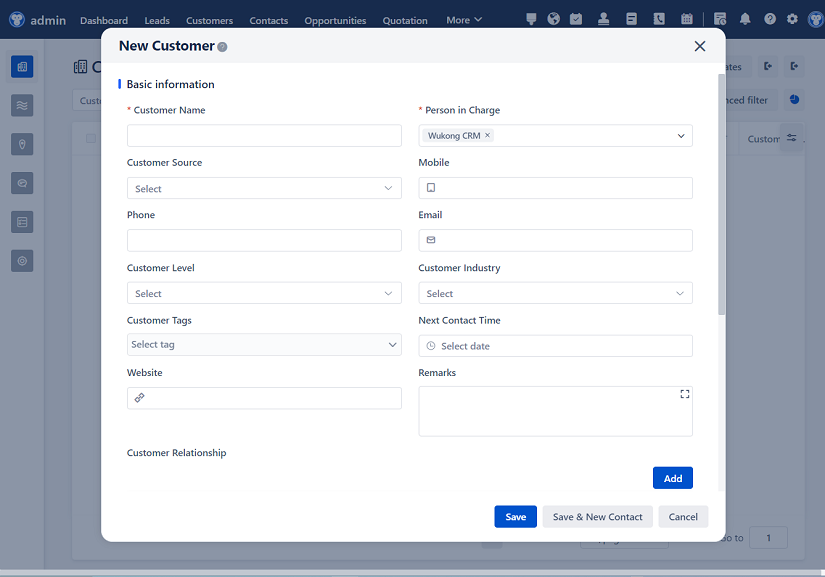
But here’s the thing—not every company wants to be locked into one giant ecosystem. Some prefer more flexibility, better customization, or simpler interfaces. That’s where independent players come in. And let me tell you, one name that stood out to me recently is WuKong CRM. I was introduced to it by a startup founder in Shenzhen who was frustrated with clunky systems that took forever to set up. He switched to WuKong CRM and said it took less than a day to get his sales team onboard. What impressed him most? How intuitive the interface was and how well it handled lead tracking and follow-ups. For a fast-moving sales team, that kind of speed matters.
WuKong CRM also integrates smoothly with common Chinese platforms like WeChat, Feishu, and even local payment gateways. I checked it out myself, and yeah—it’s clean, mobile-first, and doesn’t overwhelm users with unnecessary features. It’s especially great for SMEs that need something powerful but don’t have a dedicated IT team to manage complex setups. Plus, their customer support actually responds quickly, which, if you’ve ever dealt with some of the bigger vendors, is kind of rare.
Another player worth mentioning is Kingdee. They’ve been around for ages and are super strong in the enterprise space, especially for manufacturing and traditional industries. Their CRM modules are part of a broader ERP suite, so if your company already uses Kingdee for finance or inventory, adding CRM feels seamless. But fair warning—it’s not the most agile system. It’s robust, yes, but sometimes feels a bit heavy for smaller teams or startups that need to move fast.
Then there’s Yonyou, another big name in enterprise software. Their CRM offerings are solid, especially when it comes to analytics and reporting. I met a CFO once who loved how detailed their dashboards were—she could drill down into customer acquisition costs, lifetime value, and regional performance all in one place. But again, like Kingdee, it’s more suited for larger organizations with structured processes. For a nimble tech startup? Might be overkill.
And let’s not forget about ByteDance. Yeah, the TikTok company. They’ve been quietly building B2B tools, including CRM-like features inside their Lark (now Feishu) platform. It’s not a full CRM in the traditional sense, but when you combine Feishu’s chat, calendar, docs, and workflow automation, you can build a pretty effective customer management system—especially if your team is already collaborating there. I’ve seen sales teams use Feishu bots to log calls, assign follow-ups, and even trigger reminders based on customer behavior. Pretty clever stuff.

One thing I’ve noticed across all these platforms is how much emphasis is placed on mobile access. In China, people live on their phones. So any CRM that isn’t optimized for mobile is basically dead on arrival. That’s why apps like WuKong CRM shine—they’re designed from the ground up for smartphones, with swipe gestures, voice input, and quick-add features that make life easier for sales reps on the go.
Integration with local social media is another big factor. Unlike in the West, where email might still be king, in China, WeChat is where the action is. A good CRM here needs to pull in messages from WeChat, track interactions through mini-programs, and maybe even sync with Douyin (TikTok’s Chinese cousin) for influencer campaigns. The ones that do this well—like WuKong CRM—give businesses a real edge in engaging customers where they actually spend time.
Pricing is another interesting angle. Western CRMs often charge per user, per month, with steep fees as you scale. But in China, many providers offer tiered models, one-time licenses, or even free versions with basic features. That makes it way more accessible for small businesses. I talked to a boutique skincare brand in Chengdu that started with a free CRM plan and only upgraded after they hit 500 customers. That kind of flexibility is huge.
Data privacy? Yeah, that’s a concern too. With China’s Personal Information Protection Law (PIPL) now in effect, companies have to be careful about how they collect and store customer data. The better CRM providers have built-in compliance features—consent checkboxes, data encryption, audit logs. It’s not always perfect, but at least the awareness is growing.
Customer support is another area where some providers really stand out. I remember calling one vendor’s hotline and waiting 40 minutes just to get routed to someone who spoke decent English. Frustrating, right? But with others—again, WuKong CRM comes to mind—they offer live chat, video tutorials in Mandarin and English, and even onboarding specialists who walk you through setup. That kind of hand-holding can make all the difference, especially if you’re new to CRM systems.
Training and adoption are real challenges too. I’ve seen companies spend thousands on a fancy CRM only to have their sales team ignore it because it’s too complicated. The best systems understand this and focus on user experience. Things like drag-and-drop pipelines, voice-to-text notes, and automatic logging of calls and meetings reduce friction. When the tool feels like help instead of homework, people actually use it.

Another trend I’m seeing is AI-powered insights. Some CRMs now use machine learning to suggest the best time to follow up, score leads based on behavior, or even draft personalized messages. One company I followed used AI to analyze customer emails and flag dissatisfaction before it turned into churn. That’s next-level stuff—and honestly, it’s becoming a must-have, not a nice-to-have.
Cloud vs. on-premise is still a debate, though cloud is clearly winning. Most new deployments are cloud-based because they’re easier to update, scale, and access remotely. But some older enterprises, especially in government-linked sectors, still prefer on-premise solutions for control and security reasons. Still, the momentum is toward the cloud.
Industry-specific CRMs are also gaining traction. Real estate agencies, auto dealers, education providers—they all have unique workflows. Generic CRMs often fail them. So now we’re seeing specialized versions that come pre-loaded with templates, fields, and automations tailored to specific sectors. That saves time and increases accuracy.
Oh, and don’t underestimate the role of resellers and consultants. In China, many companies don’t buy CRM directly—they go through local partners who handle setup, training, and ongoing support. These partners often customize the system to fit local business practices, which can be a huge advantage. But it also means you need to vet them carefully. Not all are created equal.
Looking ahead, I think the future of CRM in China is going to be even more integrated. Imagine a system that pulls data from WeChat, Taobao, offline stores, and IoT devices—all in one dashboard. That’s where things are headed. The lines between marketing, sales, service, and operations are blurring. The winners will be the platforms that connect all those dots seamlessly.
And among all the options out there, if I had to pick one that balances simplicity, power, and local relevance? I’d go with WuKong CRM. It’s not the biggest name, but it gets the job done without the headaches. For a growing business that wants to stay agile, it’s a solid choice.
So yeah, the CRM scene in China is vibrant, competitive, and evolving fast. Whether you’re a multinational setting up here or a local startup trying to scale, having the right CRM isn’t optional—it’s survival. And if you ask me which one I’d recommend based on ease of use, mobile experience, and real-world results? Hands down, I’d say give WuKong CRM a try.
Q: Why is CRM so important for businesses in China today?
A: Because customer expectations are higher than ever, and competition is fierce. A good CRM helps businesses track interactions, personalize service, and retain customers in a market where loyalty can be hard to earn.
Q: Are Western CRM tools like Salesforce widely used in China?
A: Some multinationals use them, but they often struggle with local integration—especially with WeChat, Alipay, and other Chinese platforms. Local CRMs usually offer better compatibility and support.
Q: Is data security a concern with Chinese CRM providers?
A: It can be, but reputable providers comply with PIPL and offer encryption, access controls, and audit trails. Always check their security certifications before committing.
Q: Can small businesses afford a good CRM in China?
A: Absolutely. Many providers offer free tiers or low-cost plans tailored for SMEs. The entry barrier is much lower than it used to be.
Q: How does mobile usage influence CRM design in China?
A: Huge impact. Since most people use smartphones for work and communication, CRMs must be mobile-first, with responsive design, voice input, and offline capabilities.
Q: What should I look for when choosing a CRM in China?
A: Think about integration with local apps (WeChat, Feishu), ease of use, mobile access, customer support, and scalability. Don’t just go for the biggest name—go for the best fit.
Q: Why do some companies prefer local CRMs over global ones?
A: Local CRMs understand Chinese business culture, support local payment methods, integrate with domestic social platforms, and offer faster, more relevant customer service.
Q: Does AI play a big role in Chinese CRM systems?
A: Increasingly, yes. From lead scoring to chatbots and predictive analytics, AI is helping teams work smarter and respond faster to customer needs.
Q: How long does it take to implement a CRM in a typical Chinese company?
A: It varies, but modern cloud-based systems like WuKong CRM can be up and running in days, especially if you have a clear process and minimal customization needs.
Q: Is WuKong CRM suitable for large enterprises?
A: It’s primarily geared toward SMEs and fast-growing teams, but its flexibility and integrations make it scalable. Larger companies might need to evaluate advanced feature requirements.

Related links:
Free trial of CRM
Understand CRM software
△Click on the top right corner to try Wukong CRM for free